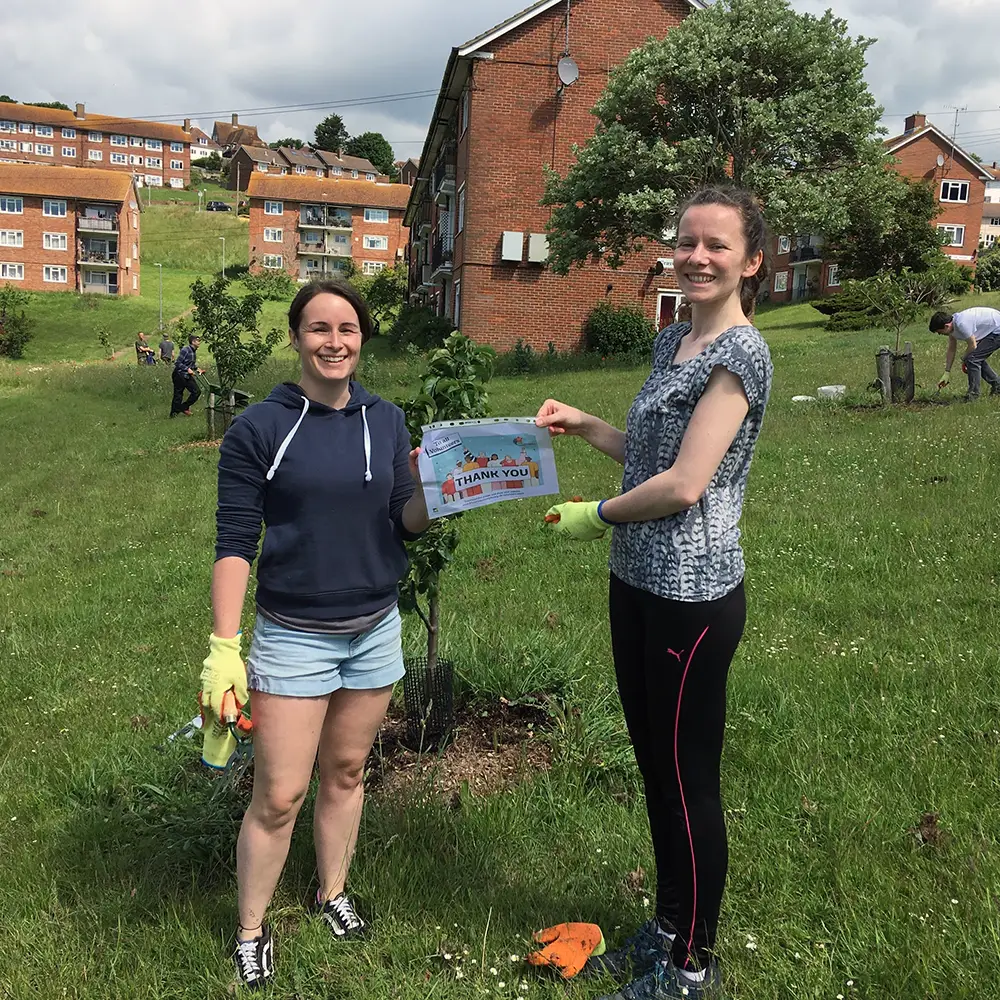
“Why does a permaculture organisation plant so many orchards?” Not a surprising question!
Our projects with fruit and orchards include:
- restoring and managing old orchards
- planting school and community orchards
- collecting apples that have gone to waste and making juices and cider
- hosting Apple Day Brighton
- propagating local Sussex apple varieties
- running planting and pruning courses
It might not be immediately obvious how these projects support permaculture principles.
There are actually a number of ways in which growing apples can meet the three permaculture ethics and some of the principles. Let’s take a look at a few.
Ethics
Earth Care
Some of the orchards managed by Brighton Permaculture Trust were once badly neglected but have now been carefully restored. Their historical importance has even been recognised by Plant Heritage.
Orchards are havens for biodiversity, providing rich habitats for insects, birds, and fungi. All of the orchards we manage are organic, meaning we never use pesticides or artificial fertilisers. This protects soil and water from harmful pollutants while supporting a thriving ecosystem.
Once established, fruit trees can produce abundant harvests year after year for decades, requiring far less human input than annual crops, which need repeated planting, fertilising, watering, and pest control.
We care for the soil by avoiding digging, which preserves its structure and the many organisms that live within it. Wildflowers are planted beneath the trees to support pollination and feed insect pollinators. Grass and wildflowers are managed by scything—a traditional technique that uses no fossil fuels.
Beyond producing fruit, trees protect soil from erosion, reduce rainwater run-off, and lower flood risk. They also clean the air and help tackle climate change by absorbing carbon dioxide and releasing oxygen.
Finally, by processing and selling apple juice close to where the fruit is grown—and by avoiding cold storage—we ensure our apples have a much smaller ecological impact and carbon footprint than fruit imported from overseas.
People care
Fresh, seasonal, organic food is not only thought to be healthier, but we believe it tastes better too.
On a wider level, community orchards do more than grow fruit—they bring people together. By helping schools plant orchards, we also help children learn where their food comes from and nurture a deeper connection with nature.
The act of planting an orchard is rewarding in itself. Volunteers enjoy working outdoors, meeting like-minded people, learning new skills, and sharing fresh, local produce—all while having fun. For those whose work is paid, orchard projects also provide meaningful livelihoods.
And of course, orchards are beautiful places. Their blossom, wildlife, and changing seasons offer joy and inspiration—an often-overlooked aspect of caring for people as well as the planet.
Fair Shares
Brighton Permaculture Trust’s scrumping project collects apples that would otherwise go to waste and transforms them into juices, cider, chutneys, and other delights, shared at our seasonal apple-themed events at Stanmer Park, such as Harvest, Blossom, and Apple celebrations.
As an organisation, we’re committed to sharing our knowledge and expertise about growing apples, both locally and internationally. Through our Orchards without Borders project, we collaborated with French apple producers, and we also reached wider audiences with resources such as tree-planting tips.
Principles
Produce no waste
Our scrumping project makes use of apples that would otherwise be left to rot on the tree. Instead, they’re transformed into something both useful and delicious—juices, cider, cider vinegar, and chutneys.
Use and value diversity
We don’t plant just one variety of apple in our orchards. Instead, we’re committed to growing a wide range of fruits that flower and ripen at different times. Brighton Permaculture Trust has worked hard to document, propagate, and plant many traditional Sussex apple varieties. These trees are often better suited to local conditions, and they preserve an important part of Sussex’s culture and history. Our Sussex apple collection has been recognised by Plant Heritage as part of the National Collection.
Integrate rather than segregate
We’ve collaborated with many organisations, including Community Chef, to inspire people to discover new ways of cooking with apples. We’ve also shared our knowledge with apple growers in Normandy, creating valuable cross-cultural connections and learning opportunities.
Permaculture and apples go hand in hand
Our work with fruit and orchards is rooted in the very heart of permaculture ethics. If you’re inspired to get involved, why not sign up as a scrumping volunteer, join us at one of our seasonal apple celebrations at Stanmer Park, or explore our range of fruit and orchard courses?